 Türkçe
 English
 Deutsch
 Русский
 Español
 Français
 العربية
 فارسی
فارسی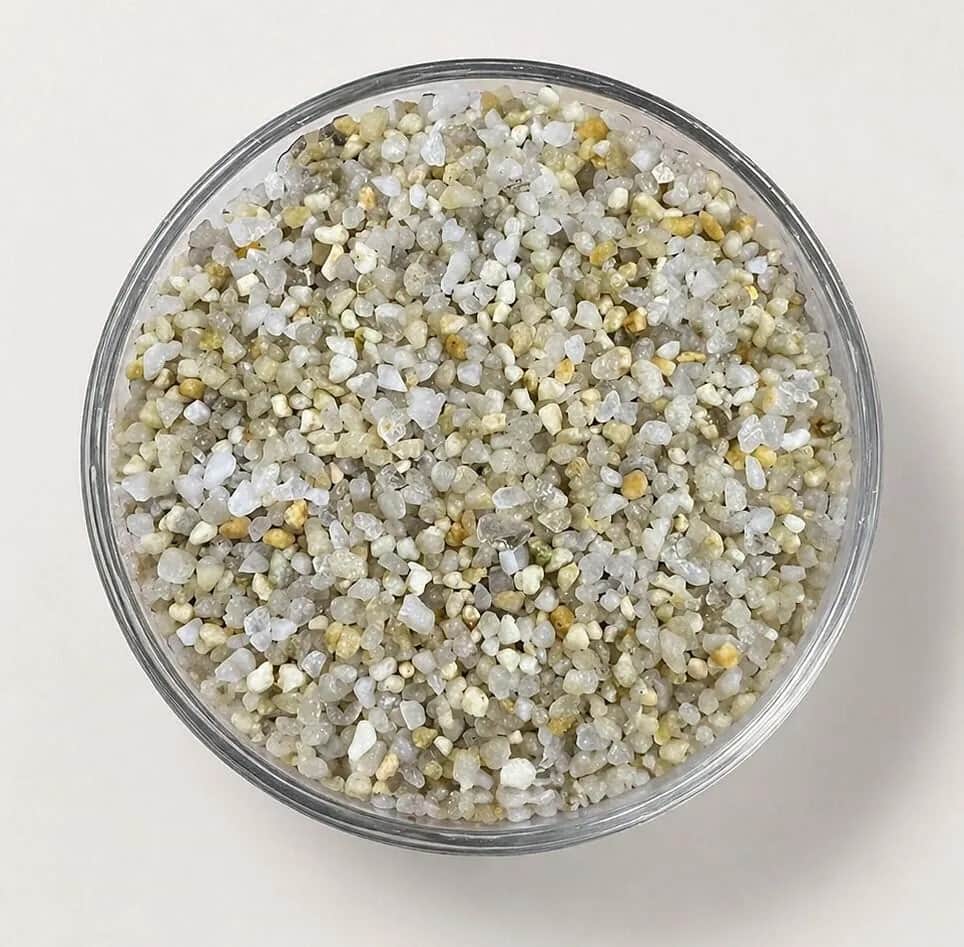
What Does the SiO₂ Level Tell You?
The SiO₂ (silicon dioxide) level shows how much quartz the sand contains. The higher the percentage, the purer the sand, the more chemically stable and the more heat resistant it is. This stability, which comes from the high SiO₂ content, is the basic reason silica sand is used so widely in industry.
However, not every application requires the highest purity. Cost rises with purity: choosing a higher grade than needed wastes budget, choosing a lower one causes problems in production.
The Grades and What They Mean in Practice
Our product family covers three purity levels:
- Above 96% SiO₂: filtration, blasting, construction and landscaping — applications where chemical purity is not decisive and mechanical strength and grading come first.
- Above 98% SiO₂: foundry, construction chemicals, precast and epoxy — applications that expect both strength and chemical stability. This is the grade with the widest field of use.
- Above 99% SiO₂: glass, refractory, ceramics and chemical applications requiring high purity.
Three Questions That Determine the Choice
1. Is the sand exposed to high temperature? In processes such as glass, refractory and casting, impurities directly affect melting behaviour and strength; purity is critical.
2. Does colour matter? If a white or colourless result is expected, the value to look at is not SiO₂ but the iron oxide level. We covered this in a separate article: Why Does Fe₂O₃ Matter?
3. Does the sand work in a chemical environment? In water treatment and chemical applications the sand must not dissolve or contaminate the medium. In filter products this behaviour is guaranteed by the TS EN 12904 standard.
Purity Alone Is Not Enough
Even with the right SiO₂ level, the result will not be what you want if the grading is wrong. In a filter, the grain distribution governs pressure loss; in casting, the AFS value governs surface quality. Purity and grain size must therefore be chosen together — neither substitutes for the other.
Let Us Determine the Grade You Need
Share your process and your expectation, and we will recommend a suitable purity grade and send a sample together with the chemical analysis values. You can reach us through the contact form.
Related pages: