 Türkçe
 English
 Deutsch
 Русский
 Español
 Français
 العربية
 فارسی
فارسی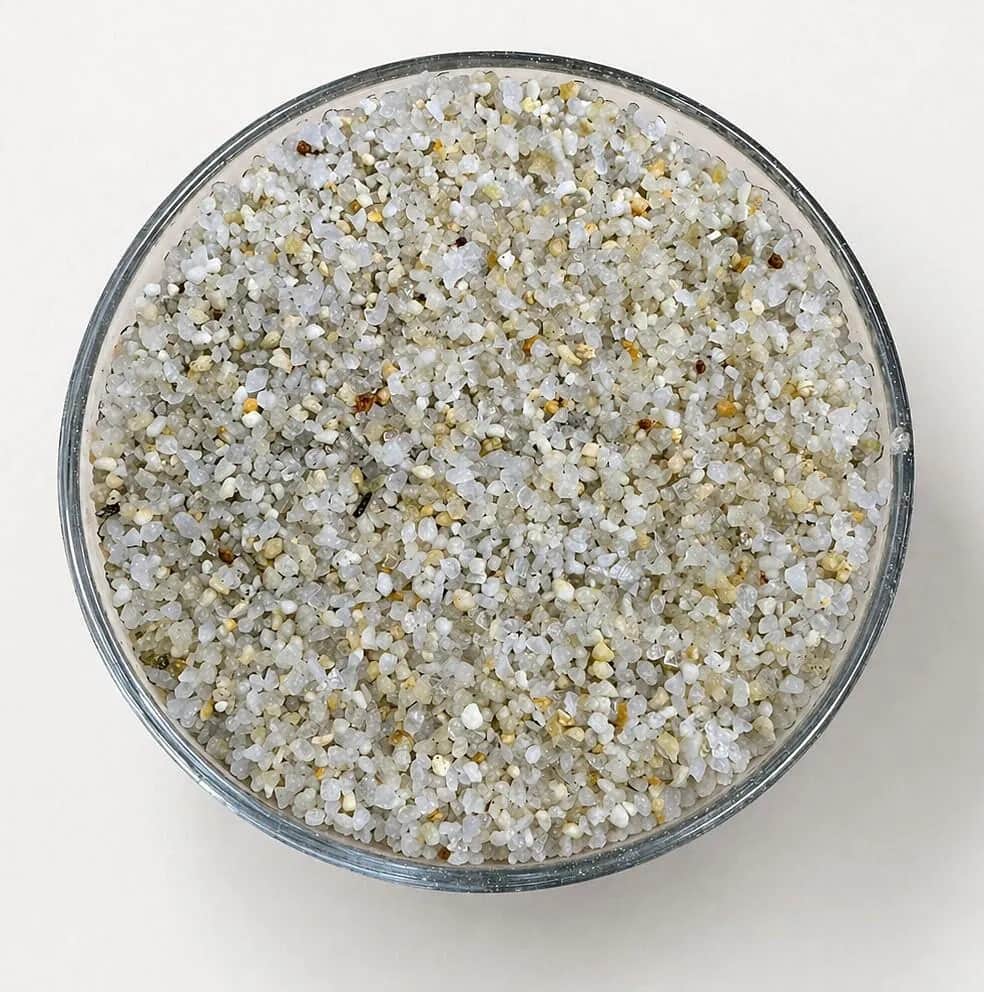
Silica sand is a natural mineral sand with the chemical formula SiO₂ (silicon dioxide) that contains high-purity silicon. It forms through the breakdown of quartz — one of the most abundant minerals in the Earth's crust — by natural processes (wind, water, temperature).
In industry, the terms "silica sand" and "quartz sand" are often used interchangeably; however, technically there are small differences between them. In this article, we examine in detail what silica sand is, what properties it has and its types.
Chemical Structure of Silica Sand
Silica sand consists essentially of SiO₂ (silicon dioxide) content. Its quality and application area depend on its SiO₂ ratio and other trace elements.
Typical composition:
- SiO₂ (silicon dioxide): 92% - 99%
- Fe₂O₃ (iron oxide): 0.01% - 0.3%
- Al₂O₃ (aluminum oxide): 0.2% - 1.5%
- TiO₂ (titanium oxide): 0.02% - 0.1%
- K₂O + Na₂O (alkalis): 0.1% - 0.5%
Important: In glass production, the iron oxide (Fe₂O₃) ratio is critical — high iron oxide gives glass a greenish tint.
Physical Properties of Silica Sand
Silica sand has superior physical properties that are the main reason it is preferred in industry:
1. Hardness
It has a value of 7 on the Mohs hardness scale. This makes silica sand extremely resistant to abrasion, scratching and mechanical impacts.
2. Melting Point
With a melting point of 1,713 °C, it withstands high temperatures. For this reason it is indispensable in the foundry industry, refractory materials and glass production.
3. Chemical Resistance
Silica sand is chemically inert. It does not react with water, acids (except hydrofluoric acid) or most bases. Thanks to this property, it is safely used in drinking water filtration.
4. Density
Density: 2.65 g/cm³ — it is a medium-density mineral, providing an advantage in transport and application.
5. Color
Depending on its purity, it can be in white, light yellow, beige and gray tones. High-purity silica sand is close to white; as its iron oxide content increases, yellowish-brown tones are observed.
6. Grain Shape
Because it forms through natural processes, its grain structure is rounded/ellipsoidal. Unlike crushed quartz grains, it is not angular, which provides an advantage in applications such as filtration and equestrian arenas.
How Does Silica Sand Form?
Silica sand forms as a result of natural processes lasting millions of years:
- Weathering of igneous and metamorphic rocks: Silica-rich parent rocks such as granite, gneiss and quartz veins break down through temperature differences, water movements and atmospheric effects.
- Transport: Free quartz grains are carried by rivers, waves and sedimentation processes.
- Accumulation: Economic deposits form in stream beds, alluvial plains, delta regions and sea coasts.
Turkey's Thrace region has rich silica sand deposits owing to its geological structure. Seyman Maden's quarries are located in Tekirdağ and Kırklareli.
Types of Silica Sand
Silica sand is divided into types according to different purity levels, grain sizes and preparation methods:
1. Washed Silica Sand
The raw material is washed with high-pressure water and cleared of clay, mud and organic residues. It is preferred for hygienic uses (children's playgrounds, beaches).
2. Dried Silica Sand
This is silica sand whose moisture has been removed in fluidized-bed dryers after washing. It is prepared for low-moisture applications such as construction chemicals, epoxy and foundry.
3. Micronized Quartz
Granular silica sand is ground to 10-200 micron sizes in ball mills. It is used in the construction chemicals, paint and ceramics sectors.
4. Granular Quartz
This is a quartz product prepared in a controlled granulometry within the 63-5000 micron range for various sectors.
5. Filter Sand
This is specially prepared, TS EN 12904 certified silica sand used in drinking water treatment. It has controlled purity and granulometry properties.
6. Filter Gravel
This is a gravel-sized silica product between 2-26 mm used in the lower support layer of filter beds.
The Difference Between Silica Sand and Quartz Sand
Although the two terms are often used interchangeably in industry, technically there are small differences:
| Property | Silica Sand | Quartz Sand |
|---|---|---|
| Formation | Through natural transport process | Can also be obtained by crushing |
| Grain structure | Rounded | Angular (if crushed) |
| SiO₂ ratio | 92% - 99% | 95% - 99%+ |
| Flow property | More stable | Depends on grain structure |
| Application preference | Filter, equestrian arena, beach | Construction chemicals, foundry, glass |
In practice: natural silica sand = natural quartz sand can be considered equivalent. The real difference is between crushed quartz and natural silica.
Production Process
At Seyman Maden, the silica sand production process consists of 4 main stages:
1. Washing
The raw material extracted from the quarry is cleaned with high-pressure water in multi-stage washing lines. Clay, mud and organic residues are removed.
2. Drying
In a natural environment or in rotary dryers, the moisture content of the raw material is reduced below 0.3%. This is critical especially for epoxy, construction chemicals and foundry applications.
3. Screening
It is separated into 6 or more fractions using multi-stage screening systems. The grain size required by each application is obtained in a controlled manner.
4. Certification
Each batch is analyzed in a laboratory environment. SiO₂ purity, moisture, granulometry and heavy metal contents are documented and delivered together with the shipment.
Frequently Asked Questions
Is silica sand harmful to drinking water?
No. TS EN 12904 certified silica sand is chemically inert and does not release any harmful substances on contact with water.
Does silica sand cause silicosis?
The use of natural, washed silica sand does not cause silicosis. Silicosis results from long-term inhalation of ground silica dust obtained through crushing. A protective mask must always be worn in dust-generating applications such as sandblasting.
Where is silica sand used at home?
It can be used at home for aquarium bases, garden drainage, children's sandpits (the washed variety) and decorative purposes.
Which silica sand is suitable for glass production?
Glass production requires high-purity silica sand with SiO₂ at 99%+ and iron oxide below 0.02%.
How many different colors does silica sand come in?
It is generally found in white, yellow, beige and gray tones. The color difference stems from the iron oxide and other trace elements it contains.
Conclusion
Silica sand is the indispensable natural raw material of modern industry. Thanks to its high purity, mechanical strength, chemical stability and heat resistance, it is actively used in more than 12 different sectors.
As Seyman Maden, we process the raw material we extract from Thrace's rich silica deposits in our modern facilities to supply TS EN 12904 certified silica sand and quartz products in controlled granulometry.
For a product and price quote suitable for your sector, get in touch.