 Türkçe
 English
 Deutsch
 Русский
 Español
 Français
 العربية
 فارسی
فارسی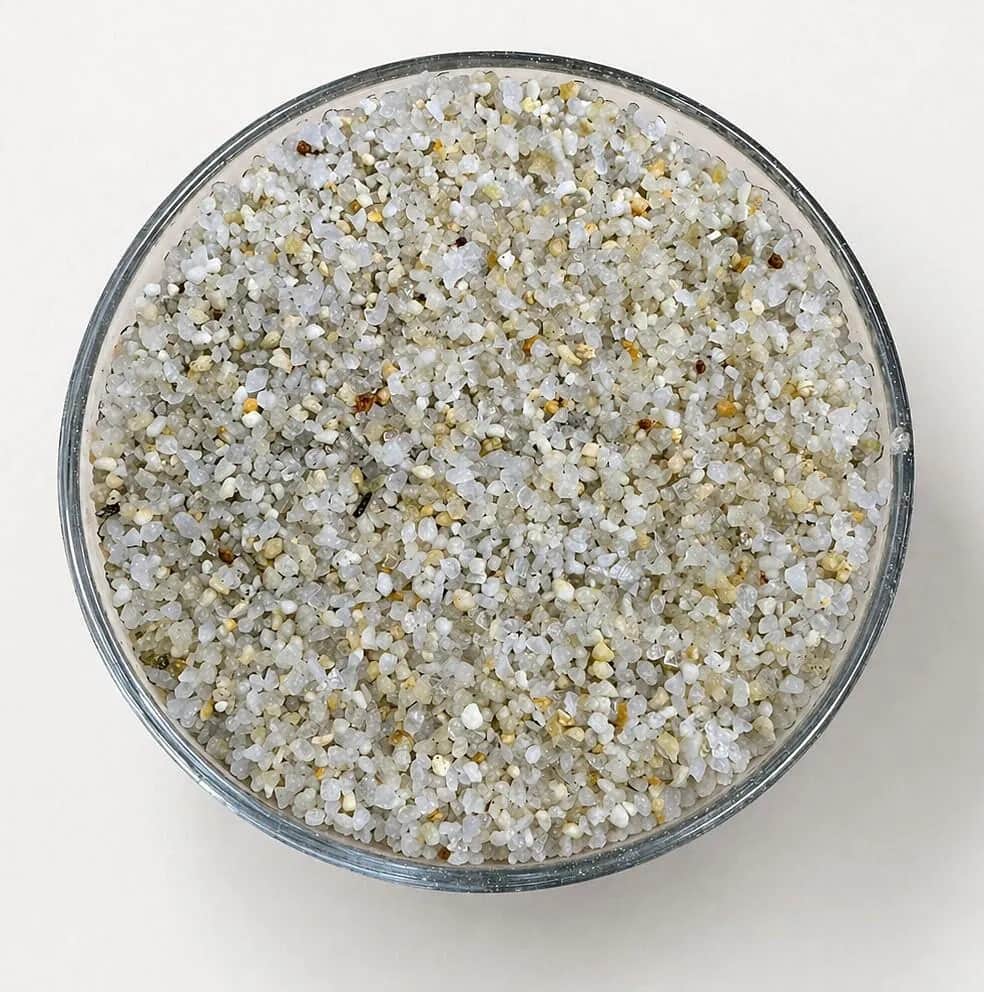
What Is Artificial Turf Sand?
Artificial turf sand is washed and screened silica sand spread beneath artificial grass surfaces and between the fibers. It keeps the grass fibers upright, adds weight and stability to the base, and allows players to move safely. Sand of the right grain size and cleanliness directly affects both the performance and lifespan of the pitch.
On artificial grass pitches, sand is not a simple filler but part of the system: it keeps the grass upright, allows water to drain, and gives the surface the feel of natural grass.
What Does Artificial Turf Sand Do?
- Keeps fibers upright: The sand that fills between the grass fibers prevents them from flattening and provides a natural appearance.
- Provides stability: It fixes the artificial grass carpet to the base, preventing rippling and slipping.
- Enables drainage: It helps rainwater descend quickly to the lower layer, preventing water accumulation.
- Absorbs impact: It reduces the load on players' joints, lowering the risk of injury.
- Balances temperature: It partially prevents the surface from overheating.
Which Sand Is Used for Artificial Turf?
On artificial grass pitches, washed, dried, and screened silica sand is used. Desired properties:
- Grain size: The 0.3 – 0.8 mm range is generally preferred. Sand that is too fine creates dust and compacts; sand that is too coarse does not fill properly between the fibers.
- Rounded grain structure: Angular sand wears down the fibers; rounded grains do not damage the grass.
- Low dust and clay: Dusty sand both creates problems for players' health and clogs drainage.
- Dryness: Moist sand clumps and cannot be spread homogeneously.
Artificial Turf Sand Grain Size Selection
| Grain Size | Use | Note |
|---|---|---|
| 0.3 – 0.5 mm | Fine infill, short-fiber grass | Firmer surface |
| 0.5 – 0.8 mm | Standard artificial turf pitch | Most common choice |
| 0.8 – 1.2 mm | Long-fiber grass, drainage priority | Faster water flow |
How Much Sand Does an Artificial Turf Pitch Need?
The requirement varies according to the grass height, fiber type, and the manufacturer's recommendation. As a general approach, approximately 15-25 kg of silica sand per square meter is used on artificial grass pitches. For example, for a standard artificial turf pitch (about 800 m²), this means around 12-20 tons of sand. For the exact amount, it is best to consult your grass manufacturer's technical documentation and to send us your pitch dimensions.
How Is Artificial Turf Sand Spread?
- The artificial grass is laid onto the base and tensioned.
- The sand is distributed evenly over the surface (by a sand-spreading machine or by hand).
- Using a brushing machine, the sand is worked in between the fibers, and the fibers are straightened.
- Brushing is repeated several times to distribute the sand homogeneously.
- Sand that compacts or diminishes over time is topped up with periodic maintenance.
Artificial Turf Sand Maintenance
Regular brushing keeps the sand distributed homogeneously between the fibers. Over time, the sand may compact or diminish with play; in that case, brushing and a sand top-up are carried out. Using clean, dust-free sand prevents drainage from clogging and extends the pitch's lifespan.
Conclusion
Artificial turf sand is the hidden determinant of the performance and lifespan of artificial grass pitches. The right grain size, cleanliness, and spreading technique directly affect the pitch's playing quality, safety, and durability.
At Seyman Maden, we supply washed, screened silica sand for artificial grass pitches from our facility in Tekirdağ to the entire Marmara region. To find out the required amount of sand and get a price quote, send us your pitch dimensions and get in touch with us.
Related Articles: